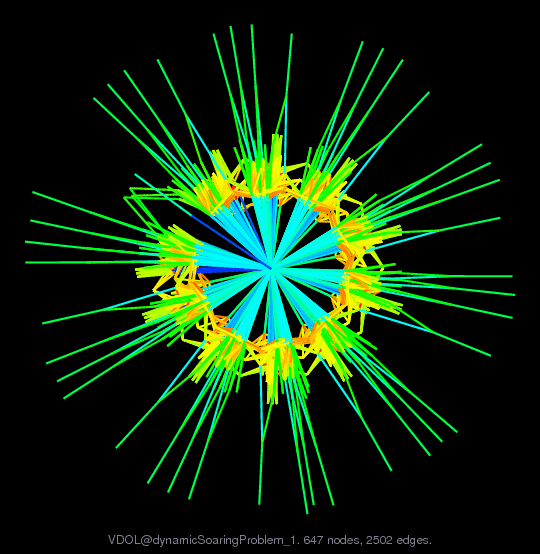
Matrix: VDOL/dynamicSoaringProblem_1
Description: dynamicSoaringProblem optimal control problem (matrix 1 of 8)
|
| (undirected graph drawing) |
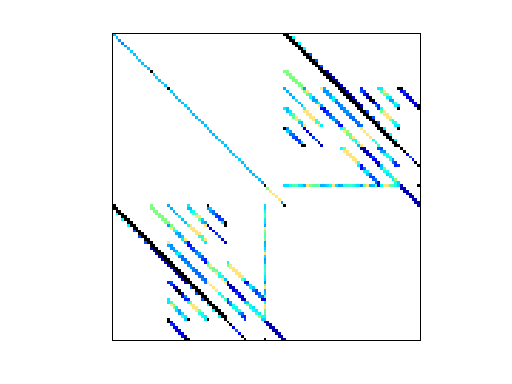 |
| Matrix properties | |
| number of rows | 647 |
| number of columns | 647 |
| nonzeros | 5,367 |
| structural full rank? | yes |
| structural rank | 647 |
| # of blocks from dmperm | 1 |
| # strongly connected comp. | 1 |
| explicit zero entries | 0 |
| nonzero pattern symmetry | symmetric |
| numeric value symmetry | symmetric |
| type | real |
| structure | symmetric |
| Cholesky candidate? | no |
| positive definite? | no |
| author | B. Senses, A. Rao |
| editor | T. Davis |
| date | 2015 |
| kind | optimal control problem |
| 2D/3D problem? | no |
| Additional fields | size and type |
| b | full 647-by-1 |
| rowname | full 647-by-99 |
| mapping | full 647-by-1 |
Notes:
Optimal control problem, Vehicle Dynamics & Optimization Lab, UF
Anil Rao and Begum Senses, University of Florida
http://vdol.mae.ufl.edu

This matrix arises from an optimal control problem described below.
Each optimal control problem gives rise to a sequence of matrices of
different sizes when they are being solved inside GPOPS, an optimal
control solver created by Anil Rao, Begum Senses, and others at in VDOL
lab at the University of Florida.  This is one of the matrices in one
of these problems.  The matrix is symmetric indefinite.

Rao, Senses, and Davis have created a graph coarsening strategy
that matches pairs of nodes.  The mapping is given for this matrix,
where map(i)=k means that node i in the original graph is mapped to
node k in the smaller graph.  map(i)=map(j)=k means that both nodes
i and j are mapped to the same node k, and thus nodes i and j have
been merged.

This matrix consists of a set of nodes (rows/columns) and the
names of these rows/cols are given

Anil Rao, Begum Sense, and Tim Davis, 2015.

VDOL/dynamicSoaring

Dynamic soaring optimal control problem is taken from
Ref.~\cite{zhao2004optimal} where the dynamics of a glider is
derived using a point mass model under the assumption of a flat
Earth and stationary winds. The goal of the dynamic soaring
problem is to determine the state and the control that minimize
the average wind gradient slope that can sustain a powerless
dynamic soaring flight.  The state of the system is defined by the
air speed, heading angle, air-realtive flight path angle,
altitude, and the position of the glider and the control of the
system is the lift coefficient. The specified accuracy tolerance
of $10^{-7}$ were satisfied after eight mesh iterations. As the
mesh refinement proceeds, the size of the KKT matrices increases
from  647 to 3543.

@article{zhao2004optimal,
  title={Optimal Patterns of Glider Dynamic Soaring},
  author={Zhao, Yiyuan J},
  journal={Optimal Control applications and methods},
  volume={25},
  number={2},
  pages={67--89},
  year={2004},
  publisher={Wiley Online Library}
}
| Ordering statistics: | result |
| nnz(chol(P*(A+A'+s*I)*P')) with AMD | 9,654 |
| Cholesky flop count | 2.4e+05 |
| nnz(L+U), no partial pivoting, with AMD | 18,661 |
| nnz(V) for QR, upper bound nnz(L) for LU, with COLAMD | 38,520 |
| nnz(R) for QR, upper bound nnz(U) for LU, with COLAMD | 54,128 |
For a description of the statistics displayed above, click here.
Maintained by Tim Davis, last updated 04-Jun-2015.
Matrix pictures by cspy, a MATLAB function in the CSparse package.
Matrix graphs by Yifan Hu, AT&T Labs Visualization Group.