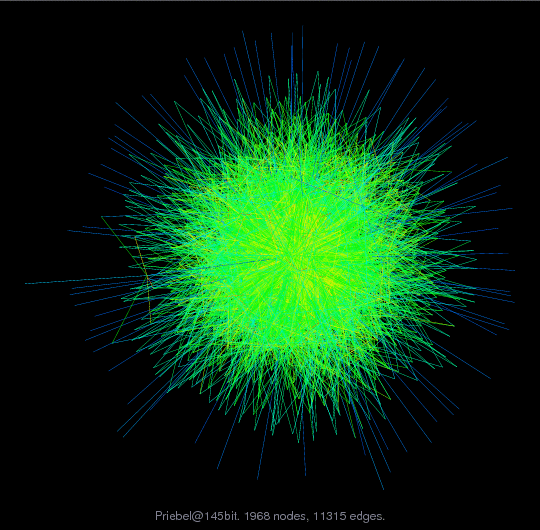
Matrix: Priebel/145bit
Description: Quadratic sieve; factoring a 145bit number. D. Priebel, Tenn. Tech Univ
|
| (bipartite graph drawing) |
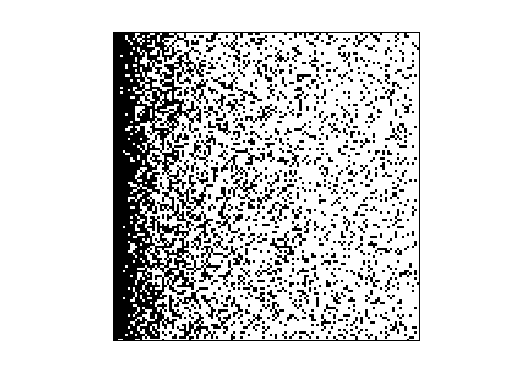 |
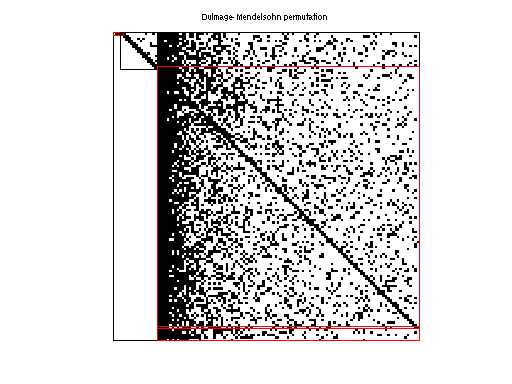 |
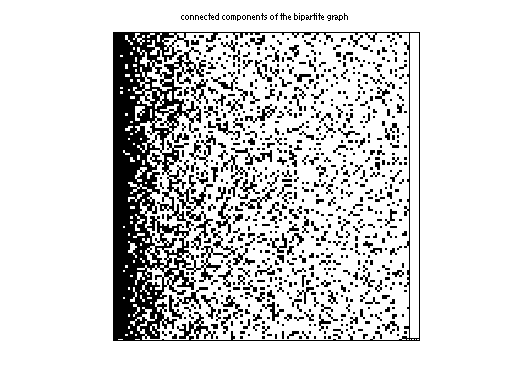 |
| Matrix properties | |
| number of rows | 1,002 |
| number of columns | 993 |
| nonzeros | 11,315 |
| structural full rank? | no |
| structural rank | 964 |
| # of blocks from dmperm | 119 |
| # strongly connected comp. | 28 |
| explicit zero entries | 0 |
| nonzero pattern symmetry | 0% |
| numeric value symmetry | 0% |
| type | binary |
| structure | rectangular |
| Cholesky candidate? | no |
| positive definite? | no |
| author | D. Priebel |
| editor | T. Davis |
| date | 2009 |
| kind | combinatorial problem |
| 2D/3D problem? | no |
| Additional fields | size and type |
| factor_base | full 993-by-1 |
| smooth_number | full 1002-by-22 |
| solution | full 385-by-1 |
Notes:
Each column in the matrix corresponds to a number in the factor base
less than some bound B.  Each row corresponds to a smooth number (able
to be completely factored over the factor base).  Each value in a row
binary vector corresponds to the exponent of the factor base mod 2.
For example:

    factor base: 2 7 23
    smooth numbers: 46, 28, 322
    2^1       * 23^1 = 46
    2^2 * 7^1        = 28
    2^1 * 7^1 * 23^1 = 322
    Matrix:
        101
        010
        111

A solution to the matrix is considered to be a set of rows which when
combined in GF2 produce a null vector. Thus, if you multiply each of
the smooth numbers which correspond to that particular set of rows you
will get a number with only even exponents, making it a perfect
square. In the above example you can see that combining the 3 vectors
results in a null vector and, indeed, it is a perfect square: 644^2.

Problem.A: A GF(2) matrix constructed from the exponents of the
factorization of the smooth numbers over the factor base. A solution of
this matrix is a kernel (nullspace). Such a solution has a 1/2 chance of
being a factorization of N.

Problem.aux.factor_base: The factor base used. factor_base(j) corresponds
to column j of the matrix. Note that a given column may or may not have
nonzero elements in the matrix.

Problem.aux.smooth_number: The smooth numbers, smooth over the factor
base.  smooth_number(i) corresponds to row i of the matrix.

Problem.aux.solution: A sample solution to the matrix. Combine, in GF(2)
the rows with these indicies to produce a solution to the matrix with the
additional property that it factors N (a matrix solution only has 1/2
probability of factoring N).

Problem specific information:

n = 27393004579711727757848513391018843988362569 (145-bits)
passes primality test, n is composite, continuing...
1) Initial bound: 20000, pi(20000) estimate: 2019,
    largest found: 17569 (actual bound)
2) Number of quadratic residues estimate: 1347, actual number found: 992
3) Modular square roots found: 1984(2x residues)
4) Constructing smooth number list [sieving] (can take a while)...
Sieving for: 1002
5. Constructing a matrix of size: 1002x993
Set a total of 11315 exponents, with 503 negatives
Matrix solution found with: 385 combinations
Divisor: 4762476283061573160587 (probably prime)
Divisor: 5751840629031342254587 (probably prime)
| Ordering statistics: | result |
| nnz(V) for QR, upper bound nnz(L) for LU, with COLAMD | 139,428 |
| nnz(R) for QR, upper bound nnz(U) for LU, with COLAMD | 150,622 |
| SVD-based statistics: | |
| norm(A) | 39.2964 |
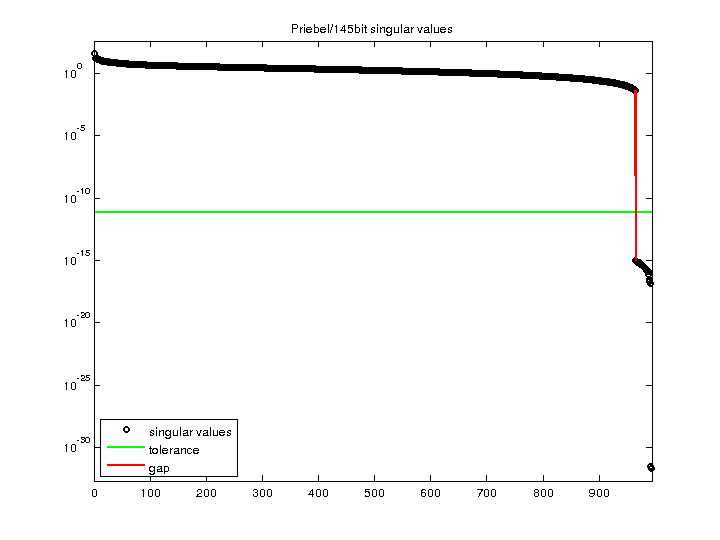
| min(svd(A)) | 2.03061e-32 |
| cond(A) | 1.9352e+33 |
| rank(A) | 964 |
| sprank(A)-rank(A) | 0 |
| null space dimension | 29 |
| full numerical rank? | no |
| singular value gap | 4.50578e+13 |
| singular values (MAT file): | click here |
| SVD method used: | s = svd (full (A)) ; |
| status: | ok |
For a description of the statistics displayed above, click here.
Maintained by Tim Davis, last updated 12-Mar-2014.
Matrix pictures by cspy, a MATLAB function in the CSparse package.
Matrix graphs by Yifan Hu, AT&T Labs Visualization Group.