Matrix: DIMACS10/preferentialAttachment
Description: DIMACS10 set: clustering/preferentialAttachment
|
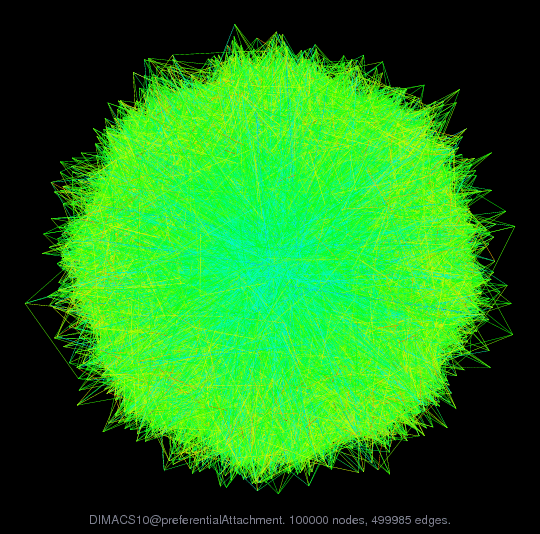
| (undirected graph drawing) |
 |
| Matrix properties | |
| number of rows | 100,000 |
| number of columns | 100,000 |
| nonzeros | 999,970 |
| # strongly connected comp. | 1 |
| explicit zero entries | 0 |
| nonzero pattern symmetry | symmetric |
| numeric value symmetry | symmetric |
| type | binary |
| structure | symmetric |
| Cholesky candidate? | no |
| positive definite? | no |
| author | H. Meyerhenke |
| editor | H. Meyerhenke |
| date | 2011 |
| kind | random undirected graph |
| 2D/3D problem? | no |
Notes:
DIMACS10 set: clustering/preferentialAttachment
source: http://www.cc.gatech.edu/dimacs10/archive/clustering.shtml

This graph has been generated following a preferential attachment
process (see Barabási and Albert, "Emergence of scaling in random
networks", Science, 1999). Starting with a clique of five vertices,
the vertices are successively added to the graph. Each new vertex
chooses exactly five neighbors among the existing vertices, such
that the probability of choosing a particular vertex is
proportional to its degree. In our implementation, a vertex can
choose a neighbour only once, such that the resulting random graph
is guaranteed to be simple.
For a description of the statistics displayed above, click here.
Maintained by Tim Davis, last updated 12-Mar-2014.
Matrix pictures by cspy, a MATLAB function in the CSparse package.
Matrix graphs by Yifan Hu, AT&T Labs Visualization Group.