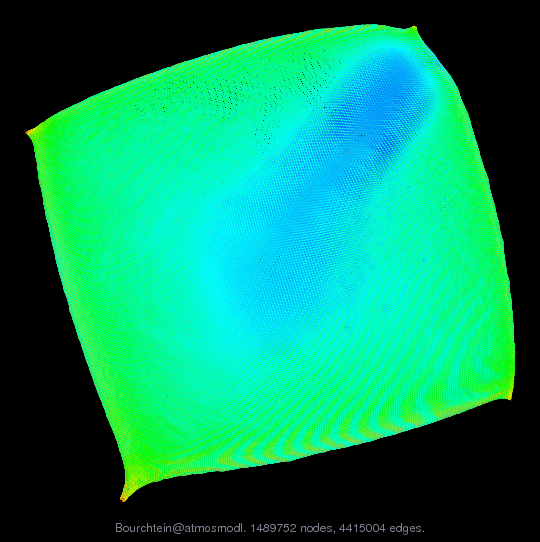
Matrix: Bourchtein/atmosmodl
Description: Atmospheric models, Andrei Bourchtein
|
| (undirected graph drawing) |
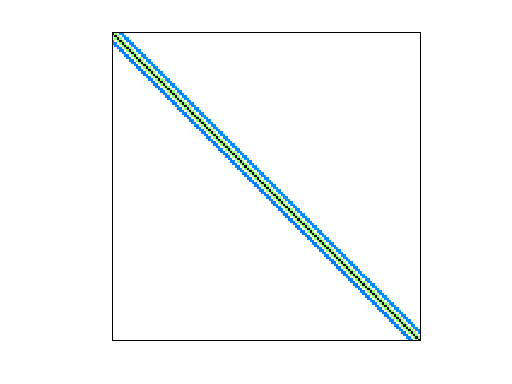 |
| Matrix properties | |
| number of rows | 1,489,752 |
| number of columns | 1,489,752 |
| nonzeros | 10,319,760 |
| structural full rank? | yes |
| structural rank | 1,489,752 |
| # of blocks from dmperm | 1 |
| # strongly connected comp. | 1 |
| explicit zero entries | 0 |
| nonzero pattern symmetry | symmetric |
| numeric value symmetry | 67% |
| type | real |
| structure | unsymmetric |
| Cholesky candidate? | no |
| positive definite? | no |
| author | A. Bourchtein |
| editor | T. Davis |
| date | 2009 |
| kind | computational fluid dynamics problem |
| 2D/3D problem? | yes |
| Additional fields | size and type |
| b | full 1489752-by-2 |
Notes:
Atmospheric modeling problems from Andrei Bourchtein

These matrices arise in the numerical weather prediction and atmospheric
modeling.  Such matrices usually appear in semi-implicit schemes applied
to three-dimensional Euler or Navier-Stokes equations (called
nonhydrostatic models in the atmospheric sciences) or to their simplified
form with hydrostatic balance equation instead of vertical momentum
equation (called hydrostatic or primitive equation models in the
atmospheric sciences).

Such linear systems represent discretization of three-dimensional elliptic
problems (frequently Dirichlet or Neumann problems for Helmholtz or
quasi-Helmholtz equations), arising at each time step of semi-implicit
algorithms due to implicit time approximation of some linear terms in the
governing equations.  If spectral spatial approximation is applied, then
the elliptic problem is usually transformed to the linear system with a
diagonal matrix solved trivially.  If finite-difference or finite-element
approximation is used, then the linear systems with the sparse matrices of
the coefficients similar to the four submitted matrices arise.  However,
the semi-implicit schemes usually do not require explicit construction of
the matrix of coefficients, neither do iterative methods used to solve
these systems in the atmospheric models.  Besides, avoiding construction
of the matrix of coefficients allows reducing the required computer
memory.  Due to these reasons, as far as I know, the explicit form of
matrices of coefficients usually is not described, except for the local
structure of the respective difference equations.

The two right-hand sides b(:,1) and b(:,2) refer to the long wave or
short wave perturbation of atmospheric fields, respectively.

The description of such semi-implicit algorithms together with arising
elliptic problems can be found, for example, in the following recent
papers (and references therein):

1. Steppeler J., Hess R., Schattler U., Bonaventura L.: Review of
numerical methods for nonhydrostatic weather prediction models. Met. Atm
Phys. 82 (2003) 287-301.

    This is a review paper on nonhydrostatic models, including
    particularly, semi-implicit time differencing.  Some description of
    arising elliptic problems and their solvers used in atmospheric models
    can be found on pp.294-296.

2. Cote J., Gravel S., Methot A., Patoine A., Roch M., Staniforth A.: The
CMC-MRB global environmental multiscale (GEM) model. Part I: Design
considerations and formulation. Mon. Wea. Rev. 126 (1998) 1373-1395.

3. Yeh K.S., Cote J., Gravel S., Methot A., Patoine A., Roch M.,
Staniforth A.: The CMC-MRB global environmental multiscale (GEM) model.
Part III: Nonhydrostatic formulation. Mon. Wea. Rev. 130 (2002) 339-356.

    This pair of papers is about hydrostatic and nonhydrostatic versions
    of the modern semi-implicit Canadian model.  Some description of
    elliptic problems and their solution can be found on p.1389 of the
    first paper and p.343 of the second paper.

4. Davies T., Cullen M.J.P., Malcolm A.J., Mawson M.H., Staniforths A.,
White A.A., Wood N.: A new dynamical core for the Met Office’s global and
regional modeling.  Q. J. Roy. Met. Soc. 131 (2005) 1759-1782.

    This is a brief report on United Kingdom modern semi-implicit model.
    Some description of elliptic problem can be found on p.1778 and its
    solution on pp.1771-1772.
| Ordering statistics: | result |
| nnz(chol(P*(A+A'+s*I)*P')) with AMD | 1,937,851,538 |
| Cholesky flop count | 2.1e+13 |
| nnz(L+U), no partial pivoting, with AMD | 3,874,213,324 |
| nnz(V) for QR, upper bound nnz(L) for LU, with COLAMD | 4,419,580,954 |
| nnz(R) for QR, upper bound nnz(U) for LU, with COLAMD | 7,841,476,026 |
For a description of the statistics displayed above, click here.
Maintained by Tim Davis, last updated 12-Mar-2014.
Matrix pictures by cspy, a MATLAB function in the CSparse package.
Matrix graphs by Yifan Hu, AT&T Labs Visualization Group.