Computer-aided Geometric and Mechanical Design
Selected publications / Opensource software
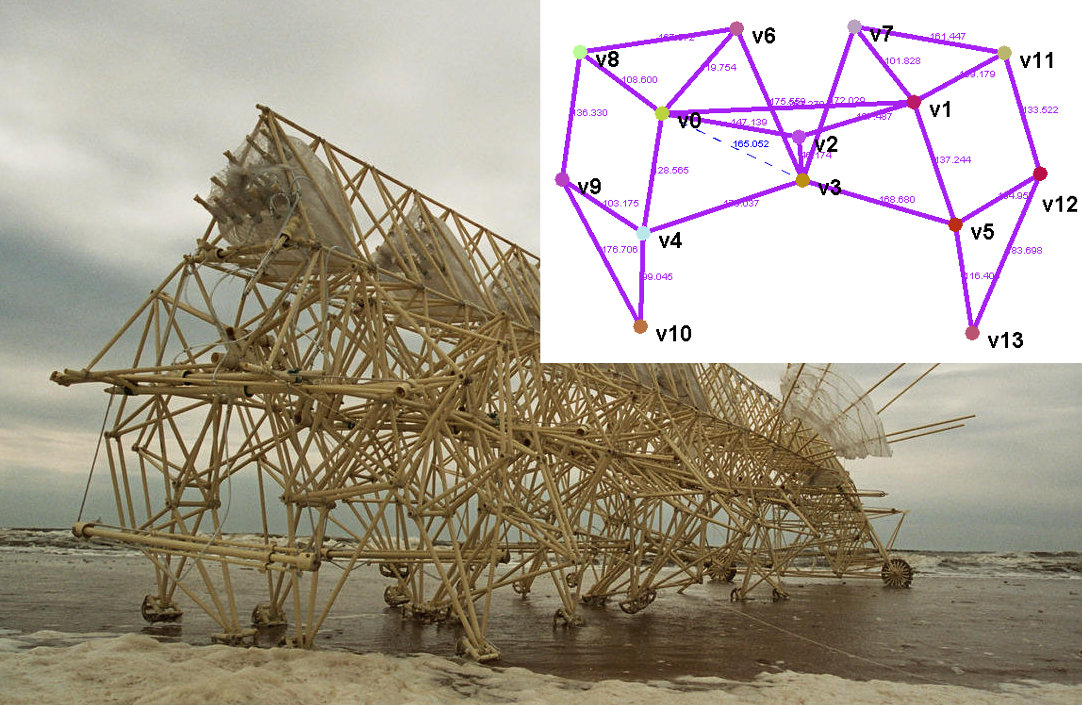
Instead of specifying parts, assemblies and mechanisms as explicit drawings to scale, ideally, one would like to simply declare various crucial geometric constraints that should hold within and between parts, and automate the actual drafting of the part, assembly or mechanism. In addition, we would like software to visualize or answer queries about the configuration or motion space of a mechanism that has been specified as a geometric constraint system. Despite the passage of 3 decades since the introduction of the concept of geometric constraint systems into the computer-aided mechanical design community, CAD systems are only able to handle a very small percentage of such tasks even for 2dimensional parts, mechanisms and assemblies.
The Sitharam group introduced and gave efficient algorithms for so-called Decomposition-Recombination planning for geometric constraint systems arising in CAD. The group then developed an opensource software called FRONTIER for geometric constraint decomposition about a decade ago (still maintained on Sourceforge). More recently, the group added efficient recombination algorithms to FRONTIER, which incorporated semi-numeric polynomial system solving, collaborating with the Peters group here at CISE.
The Sitharam group's later work on a grant provided by SolidWorks together with Mathematician Neil White, of UF, and Computer scientists Audrey Lee-StJohn and Ileana Streinu of Mt. Holyoke, Smith and UMass, provided the first formal treatment of many of the geometric constraints that are useful in mechanical computer aided design.
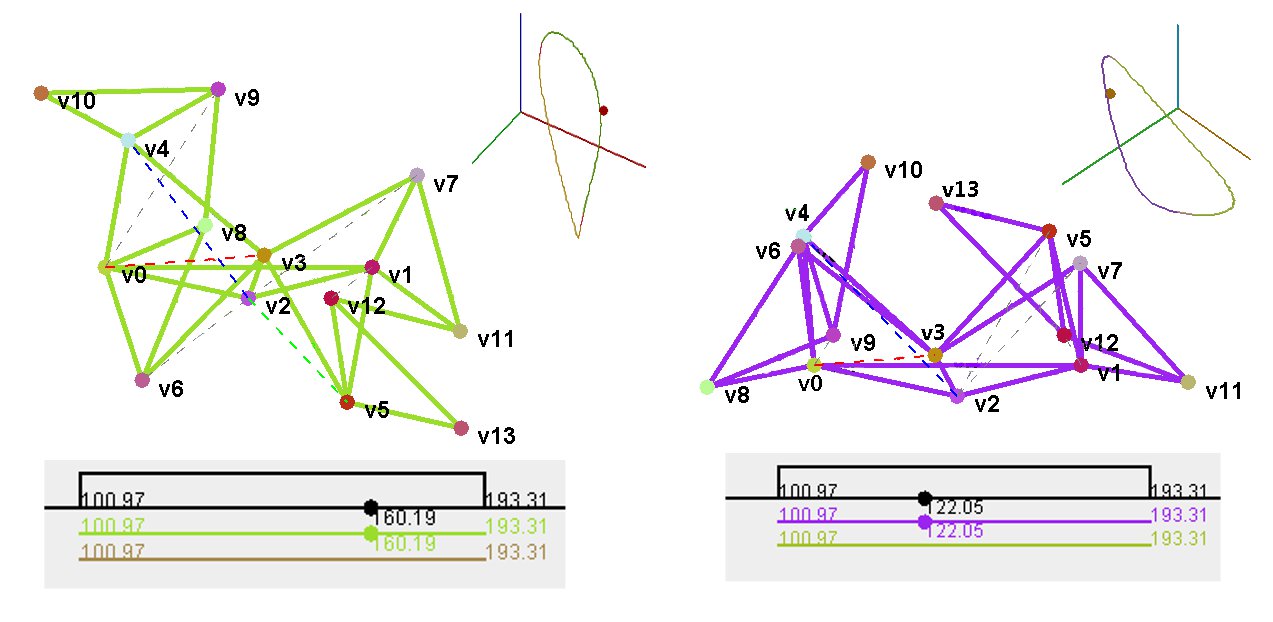 Current PhD student Menghan Wang in the Sitharam group has developed efficient algorithms and opensource software called CayMos to represent and visualize the movement of mechanisms specified using geometric constraints,
employing a new theoretical technique called Cayley analysis of linkage configuration spaces,
also developed by the group (see the page on combinatorial geometry).
In a paper accepted to the 2013 SIAM-ACM Solid and Physical Modeling conferences,
which was characterized by one of the anonymous reviewers as ''destined to become a classic in the analysis of mechanisms'',
Menghan uses CayMos to analyze and find unusual properties and motions of common mechanisms such as the well-known and amusing Strandbeest.
The paper is also published in the CAD journal.
Current PhD student Menghan Wang in the Sitharam group has developed efficient algorithms and opensource software called CayMos to represent and visualize the movement of mechanisms specified using geometric constraints,
employing a new theoretical technique called Cayley analysis of linkage configuration spaces,
also developed by the group (see the page on combinatorial geometry).
In a paper accepted to the 2013 SIAM-ACM Solid and Physical Modeling conferences,
which was characterized by one of the anonymous reviewers as ''destined to become a classic in the analysis of mechanisms'',
Menghan uses CayMos to analyze and find unusual properties and motions of common mechanisms such as the well-known and amusing Strandbeest.
The paper is also published in the CAD journal.
CayMos is web-enabled and can be found at http://www.cise.ufl.edu/~menghan/caymos.