Page 292 Exercise 12
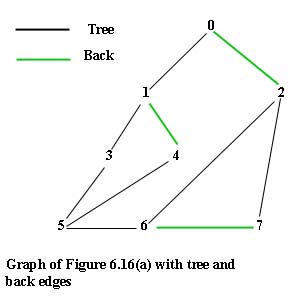
I have redrawn (below) Figure 6.16(a) with the tree edges in solid black lines , and the back edges in solid green lines. This graph illustrates the results of a depth first traversal. Assume for the purpose of the discussion that follows that v = V0, u = v1, and w = v2.
Recall that a depth first search begins with some vertex v. This vertex is marked as visited, and the search continues with v's adjacency list. Assume that an unvisited vertex u is found. The edge (v,u) is a tree edge because it connects a vertex in the tree (v) with an unvisited vertex (u). Because u is not currently in the tree, its introduction cannot create a cycle. The traversal now continues with u's adjacency list. Assume that at some
point in our traversal we examine vertex w's adjacency list, and discover that vertex u is on it. Edge (w,u) is a back edge because u appears higher in the tree than w. Adding the edge (w,u) to the tree would produce a cycle, as the diagram above illustrates. The algorithm prevents the introduction of back edges by marking ancestors as visited. Since edges that contain previously visited vertices are ignored, the algorithm excludes
cycles.