x, the maximum delay,
D(x), from x to any other node in its subtree.
If D(x) exceeds d,
the node x is deleted from T.
Consider the example tree shown below as tree (a) and assume
d = 3.
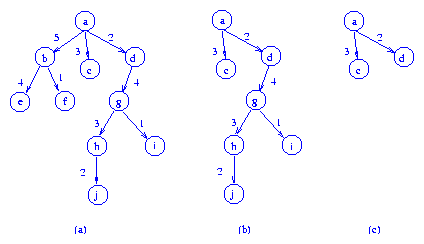
The delay,
D(x), for x
a leaf node is 0.
So, D(x) = 0 when x is any one of the nodes
{e, f, c, j, i}.
In postorder, a node is visited after its children have been visited.
When a node x is visited, its delay may be computed as:
D(x) = maxy is a child of x{D(y) + w(x,y)}
where
w(x,y) is the weight/length of the edge
(x,y).
So, D(b) = 4 and D(h) = 2.
Since D(b) > d = 3, we delete node
b to get tree (b) of the above figure.
Next, D(g) = 5
is computed and node g is deleted resulting in
tree (c).
D(d) = 0 and D(a) = 3.
No more nodes are deleted.
A high-level description of the greedy algorithm is given below.
The algorithm assumes that S has been initialized to the
empty set.
algorithm delete(t)
{// delete nodes within the subtree with root t and compute D(t)
   if (t != null)
   {
      // compute D(t)
      D(t) = 0;
      for (each child y of t)
      {
         delete(y);
         if (y is not in S)
            D(t) = max{D(t), D(y) + w(t,y)};
      }

      if (D(t) > d)
         // delete t
         add t to S;
   }
}
S
such that the removal of the vertices in S
from the tree T leaves behind a forest in which
no root-to-leaf path has a length that is more than d.
The induction is on the number,
n, of nodes
in the tree T.
If n = 0, the claim is trivially valid.
Assume the claim is valid for n <= m
where m is an arbitrary natural number.
Let T be a tree with n + 1 nodes.
Let S be the set of vertices deleted by our
greedy algorithm, and
let W be a minimum cardinality vertex set such that
the removal of the vertices in
W from the tree T
results in a forest in which there is no root-to-leaf path
whose length exceeds d.
We need to show that |S| = |W|.
If |S| = 0, this is trivially true.
If |S| > 0, then let z
be the first vertex added to S
by our greedy algorithm.
Let Tz be the subtree of
T rooted at z.
As z is added to S by
our greedy algorithm, D(z) > d.
Hence, W must contain at least one
vertex u that is in Tz.
If W contains more than one such
u, then W cannot be of minimum
cardinality as Z = W - {all such u} + {z}
is such that
the removal of the vertices in Z
from the tree T leaves behind a forest
in which there is no root-to-leaf path whose length exceeds
d.
Hence, W contains exactly one such u.
Let W' = W - {u}.
Let T' = T - Tz be the tree that results from the
removal of Tz from T.
If there is a W* such that |W*| < |W'|
and the forst that results from removing the vertices in
W* from T' has no root-to-leaf
path whose length exceeds d,
then since the forest that results when the vertices
in W* + {z} are removed from T
also has no root-to-leaf path whose length exceeds d,
W is not a minimum
cardinality deletion set for T.
So, W' is a minimum cardinality vertex set.
Also, S' = S - {z} is such that
the rmoval of the vertices in S'
from
T' results in a forest in which there
is no root-to-leaf path whose length exceeds
d and furthermore S' is the
answer produced by our greedy algorithm when started with T'.
Since the number of vertices in T' is less than
m + 1,
|S'| = |W'|.
Hence, |S| = |X'| + 1 = |W'| + 1 =
|W|.
The complexity of our greedy algorithm is easily seen to be
O(n) where
n is the number of vertices in T.