CIS 6930 Cryptographic Protocols
Analysis of Authentication Protocols
Notes on Presentation - 30th Sep, 2003
Giridharan
Sugabrahmam (gsugabra@cise.ufl.edu)
Outline
of the Topic - http://www.cise.ufl.edu/~gsugabra/outline.doc
(Size: ~ 2 MB)

- Introduction
Authentication merely ensures that the individual is
who he or she claims to be. If every
device communicating on behalf of a person or other entity shared a secret key
with every other such device, and these keys were never compromised, canceled,
unsubscribed, or otherwise expired, then basic authentication protocols might
be unnecessary. But this wont be the case. So we require an authentication
protocol that can establish a key for a secure communication session. An
authentication protocol is an exchange of messages having a specific form for
authentication of principals using cryptographic algorithms.
The Needham and Schroeder authentication protocol revolutionized security in distributed systems. An Adaptation of this protocol - Kerberos has become universal. However, it was not long before a flaw was found in this protocol. Needham and Schroeder then published a revised version of their protocol.
The existence of a subtle flaw in a previously trusted protocol stressed the need for formal methods for analyzing authentication protocols. In fact, many authors [BAN, GNY et all] praise the merits of their analysis techniques with their ability to discover the flaw in the Needham and Schroeder protocol.
2. Approaches to the Analysis
- Type I - Verification Tools
Ø Model and verify protocols using specification languages and verification tools not specially developed for the analysis of such protocols.
Ø The idea is to treat a cryptographic protocol as any other program and attempt to prove its correctness
Ø One of the tools: LOTOS for Protocol Specification models
Ø Problem: No concrete results have been reported using this method.
Ø Use of Finite State Machines for analysis - they do not guarantee security from an active intruder.
This type was able to prove the correctness of the protocol alone, however it failed to prove the security of the protocols.
- Type II - Expert Systems
Ø Protocol designers develop and investigate different scenarios.
Ø Begin with an undesirable state and attempt to discover if this state is reachable from an initial state
Ø Identifies flaws better than Type I approach but still security is not guaranteed.
Ø Useful for analyzing known weaknesses in protocols, and generating message lists to exploit those weaknesses.
- Type III - Algebraic Term-rewriting properties
Ø Based on the algebraic term-rewriting properties of cryptographic systems. -- Introduced by Dolev and Yao
Ø Considers Authentication protocol as exchange of words.
Ø Define
Algebraic operations on these words, such as encryption and decryption.
Ø More
recent applications have provided automated support for the analysis, and have
enabled a user to query the system for known attacks.
Ø The Type III approach generally involves an
analysis of the attainability of certain system states. In this regard, it is
similar to Type II approach.
Ø However, the Type III approaches try to show
that an insecure state cannot be reached, whereas the Type II approaches began
with an insecure state and attempted to show that no path to that state could
have originated at an initial state.
- Type IV - Logics (Most Commonly used approach)
Ø Doxastic logic – Based on belief. The reasoning system uses rules about how belief is propagated to establish new beliefs.
Ø Epistemic logic - Based on knowledge. The reasoning is similar to reasoning in doxastic logic, but these logics are used to reason about knowledge instead of belief.
- Needham and Schroeder’s Shared key protocol – Used by many authors to check their analysis techniques.
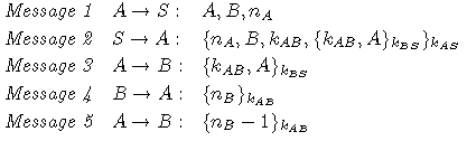
We
represent a protocol step as A à B: Message. The Figure below shows the
Needham and Schroeder’s Shared key protocol [NSSK] authentication protocol.
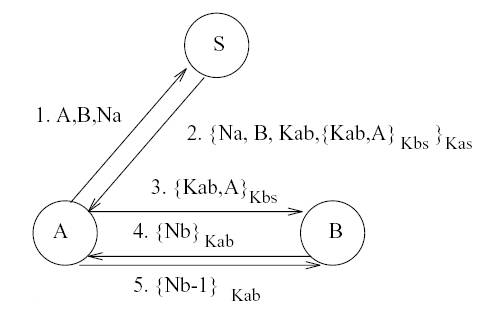
- Type IV – LOGICS (in detail)
BAN Logic – Discussed by Dr. Nemo
- BAN Notation & Rules
Discussed by Dr. Nemo
- Goals of Authentication
First level beliefs:
·
A believes A  B
B
·
B believes A  B
B
Second level beliefs:
·
A believes B believes A  B
B
·
B believes A believes A  B
B
Any logic-based method to analyze an authentication protocol will try to derive these two levels of beliefs in order to state that the authentication protocol is flawless. To derive the beliefs, we make use of the Rules, assumptions and notations of a particular logic method, say BAN in this case.
The Denning - Sacco Attack on
Needham Schroeder’s protocol
[BAN Analysis of NSSK protocol available in the following link]
[ http://www.cise.ufl.edu/~gsugabra/analysis.pdf - (page number 8- Section 2.3) ]
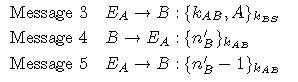
- This Attack relies on the fact that Bob has no way to actually be assured that Message 3 is fresh.
- Attacker spends time till KBS expires and cracks the KBS key to
get the session key. Attacker can work till lifetime of KBS.
- This attack
is not directly uncovered by a BAN analysis of the protocol; When BAN logic is
used to derive the goals of authentication, some where in the middle, we will
have to make a dubious assumption that B believes fresh ( ). Without
making this assumption we cant proceed with the analysis of NSSK (Needham
Schroeder’s Shared key exchange protocol) using BAN. After making this
assumption we were able to derive the correctness of the NSSK protocol by
deriving the authentication goals stated above. But in fact there is a flaw in
NSSK protocol that couldn’t be discovered by BAN analysis because of the
dubious assumption.
). Without
making this assumption we cant proceed with the analysis of NSSK (Needham
Schroeder’s Shared key exchange protocol) using BAN. After making this
assumption we were able to derive the correctness of the NSSK protocol by
deriving the authentication goals stated above. But in fact there is a flaw in
NSSK protocol that couldn’t be discovered by BAN analysis because of the
dubious assumption.
Flaw in BAN logic ~~~ as Claimed by The Nessett Protocol
(This is why BAN logic was extended)
The following is the Nessett protocol for authentication, which he used to claim that BAN logic has a flaw in it.

Nessett said that a significant flaw exists in BAN logic. He went ahead with the following steps to derive the goals of authentication.
Idealized Nessett Protocol
Annotation Premises
Initial State Assumptions
Nessett Protocol Derivations
First order
B
believes 
A believes 
Second order
A Believes B believes 
B Believes A believes 
From the Derivation of the Goals of authentication, BAN analysis proves that Nesett protocol is flawless. But in fact the message one is almost in clear text.
Message 1: {nonce of A,
Symmetric KeyAB }k-1A
Anybody can decrypt this message 1 by using the key KA (Public key of A) and get to know the symmetric key KeyAB. So this protocol in fact has a major flaw, but BAN analysis wasn’t able to detect the flaw in the protocol. This is what Nesett argued.
BAN replied back saying that Nesett had made a blunder in making the Initial state assumptions. Nesett makes an assumption that KAB is a good key for A and B alone (which is in fact a wrong assumption). BAN replied that this absurd assumption lead to absurd conclusions.
But still people felt that there is a need to detect flaws in such protocols, but they couldn’t express the protocol using the notations in BAN. This motivated many people to come up with new logics, which extended BAN by adding more notations in them.
Extensions of BAN -- GNY, AT, VO
- Built over BAN logic
- Each one Brought distinct addition
- SVO Logic --Unified the predecessors
SVO
SVO
presented a logic for analyzing cryptographic protocols which encompasses a
unification of four of its predecessors in the BAN family of logics, namely
those given in [GNY90], [AT91], [vO93], and BAN itself [BAN89]. It was also
compatible with the four logics GNY, VO, AT and BAN. It means that the
notations in any of these four logics can be represented through SVO. And SVO
had many more notations, which were not expressible by other logics. This made
SVO very powerful by combining all other logics and having its own new
notations.
The
Notations, Axioms and Rules are given in the Outline. The link to outline is
specified in the beginning of this document. The SVO Notations are
self-explanatory.
Steps
followed by SVO to analyze a protocol:
- No idealization Required
-
Mention Initial State Assumptions
-
Received Message Assumptions (Annotated protocol)
-
State Comprehension
Assumptions
-
State Interpretation
Assumptions
-
Derivations – First order & Second Order
The following are the differences
between BAN Analysis and SVO analysis.
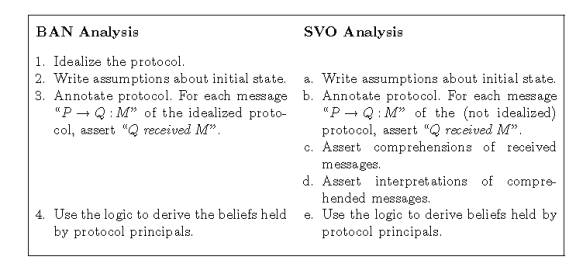
Mention Initial State
Assumptions:
Unlike BAN, we do
not idealize the protocol first. These Assumptions vary for each protocol. The
outline mentions the NSSK initial state assumptions. These assumptions are the
ones, which each principal believes before the protocol run. (Few assumptions
are common… like A and B believes that they have a key which holds good to communicate
with S. -- KAS and KBS, respectively. …. A and B believe that S controls their
symmetric key. Now we will have to derive that this key is good and whether A
and B believe that it is good – First order goal of authentication … and so
on.)
Note that P8
mentioned in Initial state assumptions of NSSK protocol (refer outline) is a
dubious assumption.
Received Message Assumptions (Annotated
protocol):
This step is the
same as the annotation assumptions in BAN, except that the specified protocol
is used, not its idealization. This means that plaintext is not eliminated and
these premises can be read directly from the specification.
If the
specification says A à S: {nonce} we convert it into something like,
S received {nonce}
Idealization:
Idealization is split into comprehension and
interpretation.
Comprehension
Assumptions:
In this step, we
express that which a principal comprehends of a received message. The move from
the received message assumptions is usually straightforward in practice.
Example:
Specified
protocol: A à S: (A, B, nA)
Annoted
protocol: S received (A, B,
nA)
Comprehension
Assumptions: S believes S
received (A, B, <nA>*s)
If you take a look
at the Comprehension Assumptions made for NSSK protocol analysis (in the
outline), it has few Asterisks symbols before S, A and B in P14-18. The
notation <X>*P means that either P doesn’t know X or doesn’t
recognize X.
Therefore in the
Comprehension Assumptions we mention an asterisk + principal’s name to denote
that the principal doesn’t know the value inside angular brackets.
Interpretation
Assumptions:
These assumptions
are essentially the replacement for idealization. In these assumptions, we have
to assert how a principal interprets a received message (as that principal
understands it).
In idealization, there is a natural and correct tendency to interpret message components using formulae expressing the intent of the sender. By placing interpretation after annotation and comprehension, the focus naturally shifts to how the intent of the sender is understood by the receiver. That is, focus shifts from the meaning the sender had intended to the meaning that the receiver attaches to a received message.
Refer to P19-P22 in outline for NSSK Interpretation assumptions.
The interpretation
premise for the first message is omitted because it will play no role in the
derivations. Mostly we stress the freshness of the key and how good the key is,
in the Interpretations assumptions. Then we combine two or more assumptions.
Derivations
for Sender and Receiver:
Once we are done
with the assumptions, we can derive the beliefs based on the axioms and rules.
The outline specifies the derivations of the goals for sender and the same
logic can be used to derive goals for receiver. But it still makes a dubious
assumption, by which SVO concludes that failed proofs sometimes reveal attacks.
If we don’t mention the dubious assumption then we cant prove this protocol. So
SVO concludes that this NSSK protocol has a flaw.
The Nessett Protocol
in SVO
The Nessett Protocol
(mentioned in page 4) claimed that BAN logic had a flaw. And BAN fought back
saying Nesett made absurd assumptions. SVO can be used and can prove that
Nesett protocol has a flaw. This is achieved by making use of the negation
notation.
Lets say E is an
eavesdropper. So we can place a requirement,
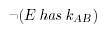
Now it is
perfectly reasonable, for every message M of this protocol to add to the
annotation assumptions that E received M. It then becomes trivial for the
Nessett protocol to derive

… which proves that
Nesett protocol has a flaw.
Links:
Outline: http://www.cise.ufl.edu/~gsugabra/outline.doc
NSSK Analysis: http://www.cise.ufl.edu/~gsugabra/analysis.pdf
[Using BAN logic:
(page number 8 - Section 2.3)]
[Using SVO logic:
(page number 20 - Section 3.4)]