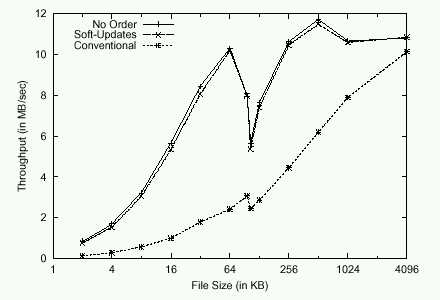
- The following image shows the results (given as throughput in
megabytes/second) of creating files of various
sizes using Conventional FFS, No Order FFS, and Soft-Updates
FFS. As expected, both Soft-Updates, and No Order outperform
conventional FFS. Operations were performed on 25 runs each,
yielding a coefficient of variation of less than 0.07.
- The next image shows the results (in files/second) of deleting
files of various sizes. In this case, the coefficients of variaton
are below 0.1 with the single exception of the 4096 KB point, for
which the coefficient of variation is 0.13.
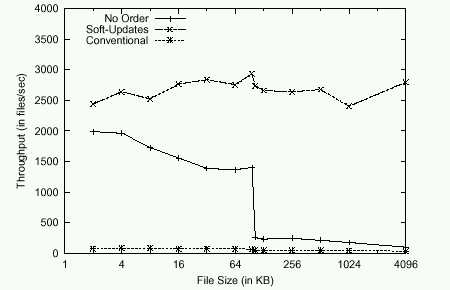
Soft-updates outperforms No Order in this case because No Order
actuall must delete the files in the foreground. The big No
Order drop occurs at the 104 MByte boundary.
Several points of interest are the following:
- 64 KB (after which a file will require two contiguous
data segments)
- 104 KB (after which a file will require and indirect
data block)
- 1024 KB (after which all the data of a file cannot be
stored in a single cylinder group)
- The following image shows read performance (measured in
MBytes/sec) as a function of file size. In this case the
coefficients of variation are less than 0.04.
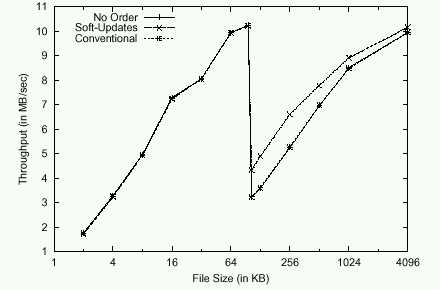
After files reach 96 KB, FFS uses a reallocation
scheme to keep files contiguous. Delaying deallocations lets
Soft Updates avoid placing indirect blocks in undesirable
locations.
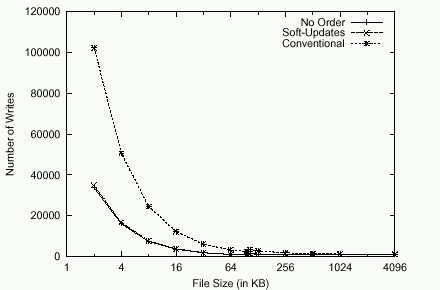
- The final figure shows the number of disk write operations
carried out during the file creation benchmark.
Conventional FFS requires several more writes to create
a file than either No Order or Soft Updates. The gap
between the systems decreases partly because the number of
files created decreased in the benchmark as the files got
larger.
- A file system with Soft Updates can be repaired using
fsck in significantly less time than a conventional
file system. In a conventional file system, fsck
requires 5 seconds on an empty file system and 150 seconds on
a 76% full file system. A Soft Updates file system
fsck requires 0.35 seconds in either case.
Testing the repair performance of Soft Updates by halting a
benchmark in process showed no errors, whereas the conventional
file system required off-line assistance before being usable
in 96% or attempts, and the No Order file system yielded
unresolvable inconsistencies (a disk block appears in more
than one file) in 30% of trials.
- Soft Updates provide a 4-19% benefit in system throughput over
a traditional logging file system (presumably due to extra I/O
required to maintain the log).