The Virtual Anesthesia Machine

Figure 1: The Virtual Anesthesia Machine (VAM).
The VAM is an interactive online 2D simulation of a generic anesthesia machine, created as a learning tool for anesthesiology educators, students and other medical personnel needing to learn about anesthesia machines. Since 1999 the VAM user base has grown to 30,000 registered users and has more than a billion hits per year. Students perform exercises with the VAM simulation before training with real anesthesia machines. These exercises teach students general concepts that can be applied to many anesthesia machines (such as gas flow, manual and automatic ventilation, filtering exhaled gasses etc.)
The major visible and invisible components of a real anesthesia machine are represented in the VAM with animated 2D icons. For example, invisible gas flow is represented by color-coded particles (i.e. green particles are O2; blue particles are N2O). Students interact with the components by clicking on the icons with a mouse. For example, users can click on the O2 knob and then drag the mouse to turn the knob. This interaction increases the simulated flow of O2, which is visualized by an increase the speed of the green O2 particles.
The VAM’s abstract representation offers two major learning benefits over a real anesthesia machine:
1. The VAM visualizes internal components and invisible gas flow of the anesthesia machine.
2. The components in the VAM have been spatially reorganized to make visualization of the gas flow more convenient to visualize, easier to understand, and applicable to many anesthesia machines.
By visualizing and interacting with the VAM’s abstract representation, the user can learn how the gas particles flow between the components of the anesthesia machine. This gas flow cannot be directly observed in a real anesthesia machine. For example, consider figure 2. In the real anesthesia machine, there is a complex pneumatic connection between the flow meters (A) and the vaporizer (B). This connection is hidden in the real machine. By observing the real machine, a student could not learn that gas flows from (A) to (B). However, In the VAM, this pneumatic connection is: (1) visualized, and (2) simplified due to the spatial reorganization of (A) and (B). The color-coded gas particles flow through the visualized pneumatic tubes to demonstrate the flow between (A) and (B). The VAM visualization enables anesthesiology residents to better understand the gas flow. This understanding is necessary for anesthesiologists to quickly find and repair faults in the machine.
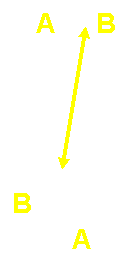
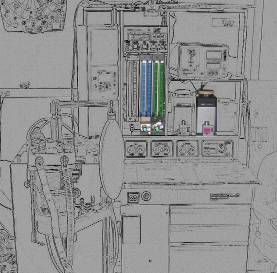
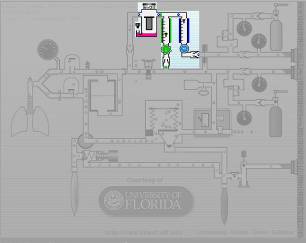
Figure 2 : Top: a real anesthesia machine with the flow meters (A) and the vaporizer(B) highlighted. Bottom: the flow meters and vaporizer are spatially reversed in the abstract representation of the Virtual Anesthesia Machine (VAM).