Introduction
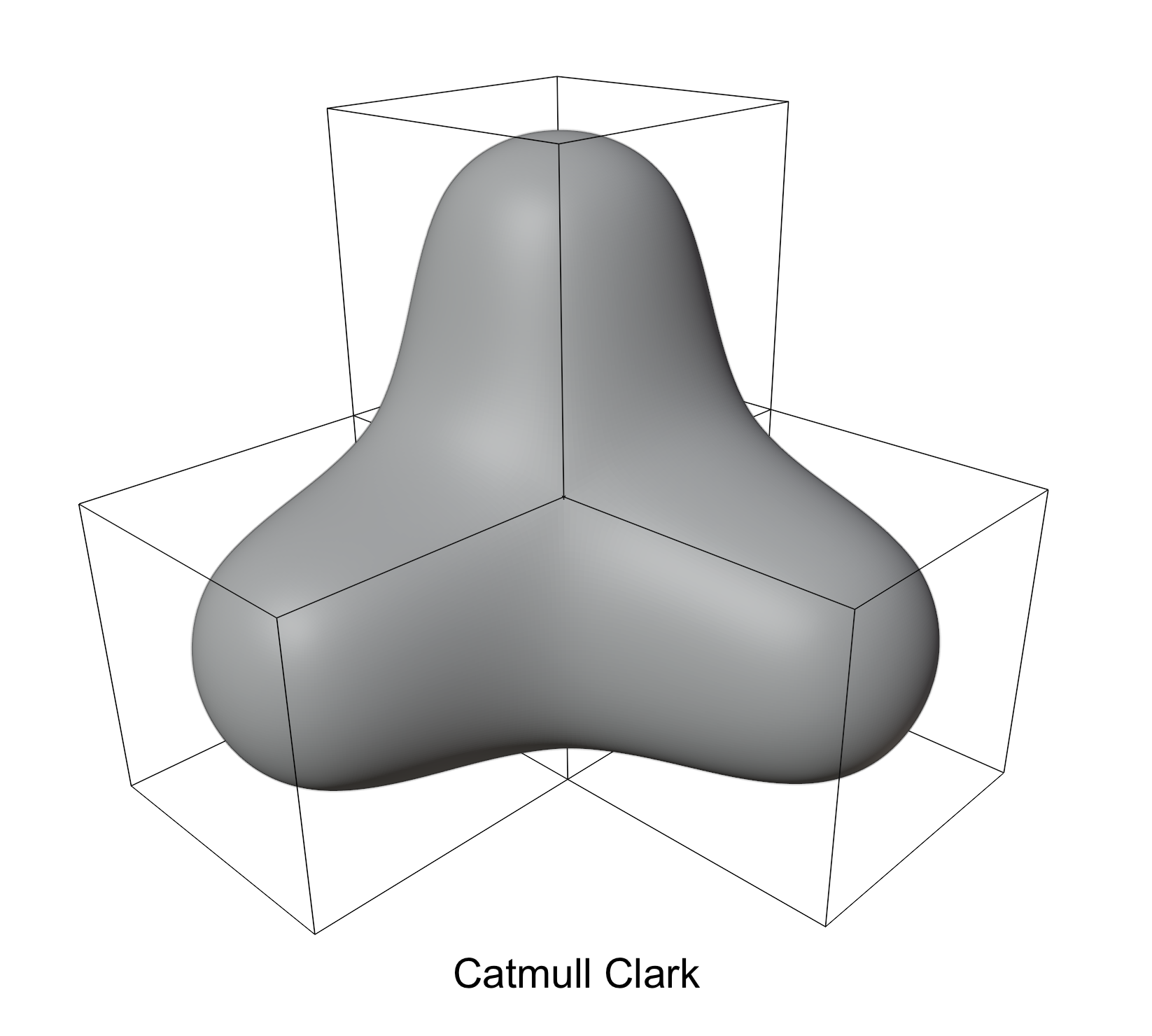
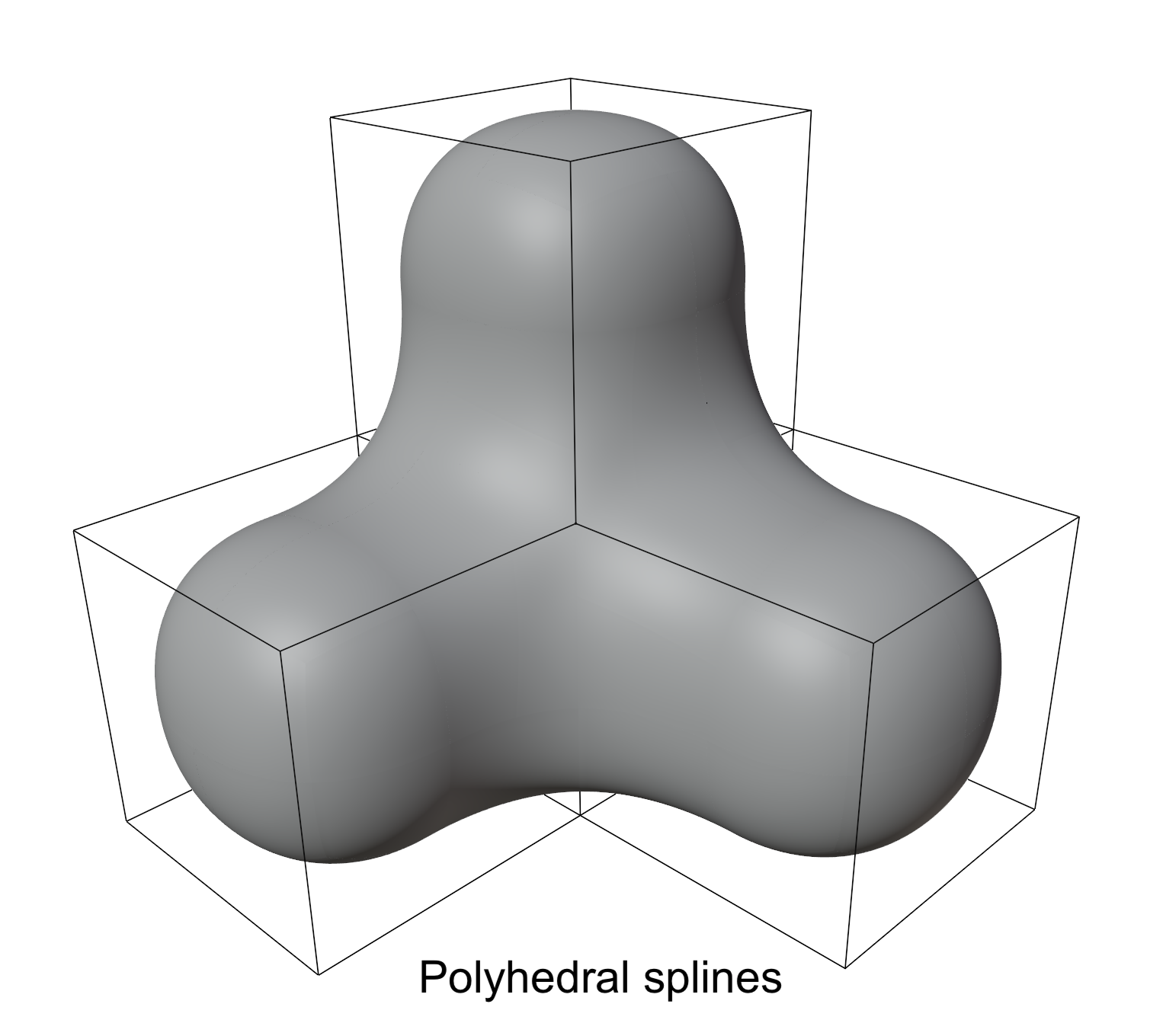
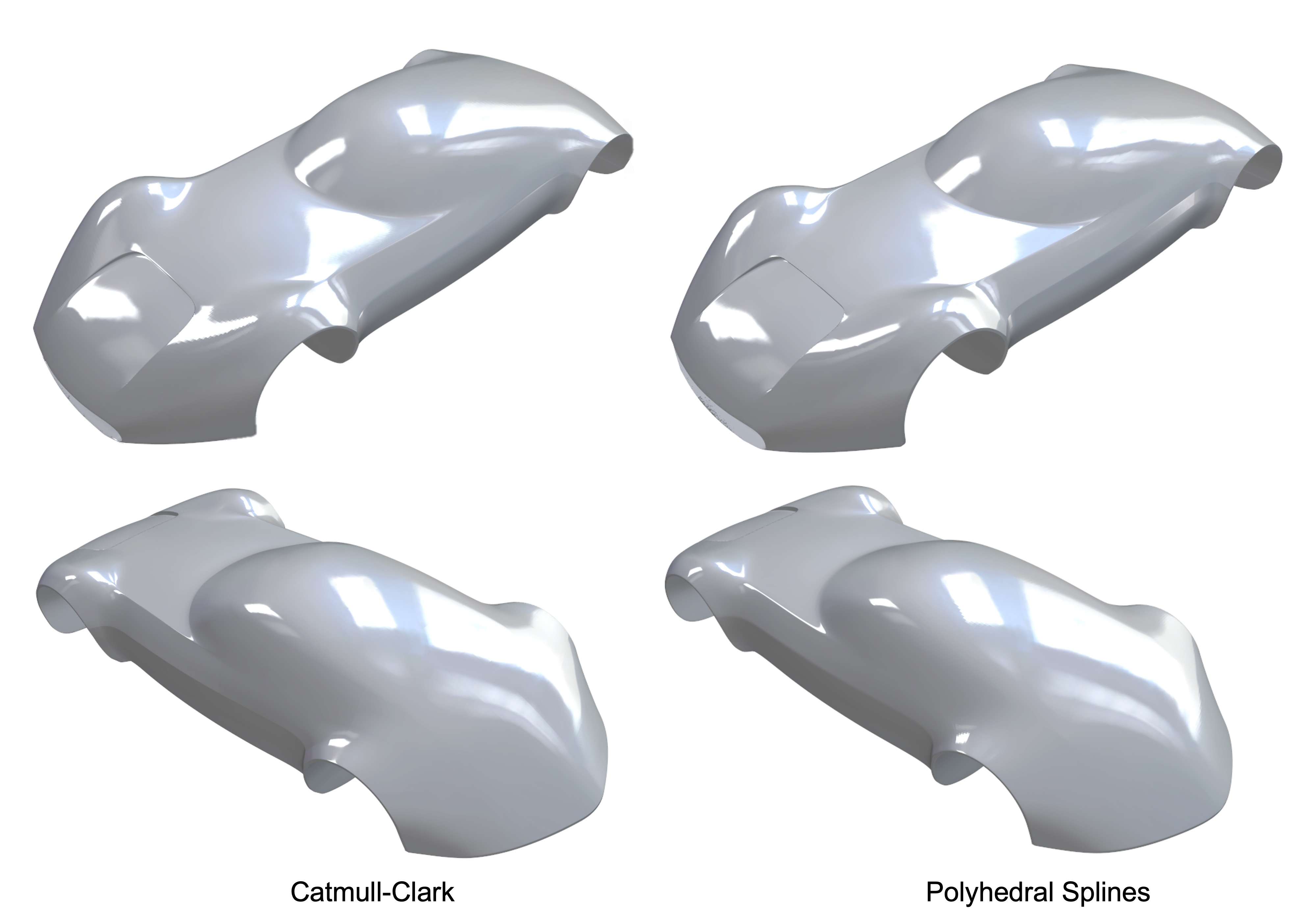
Polyhedral-net splines (PnS2) convert a polyhedral-net into piecewise Bezier patches of degree no more than bi-3
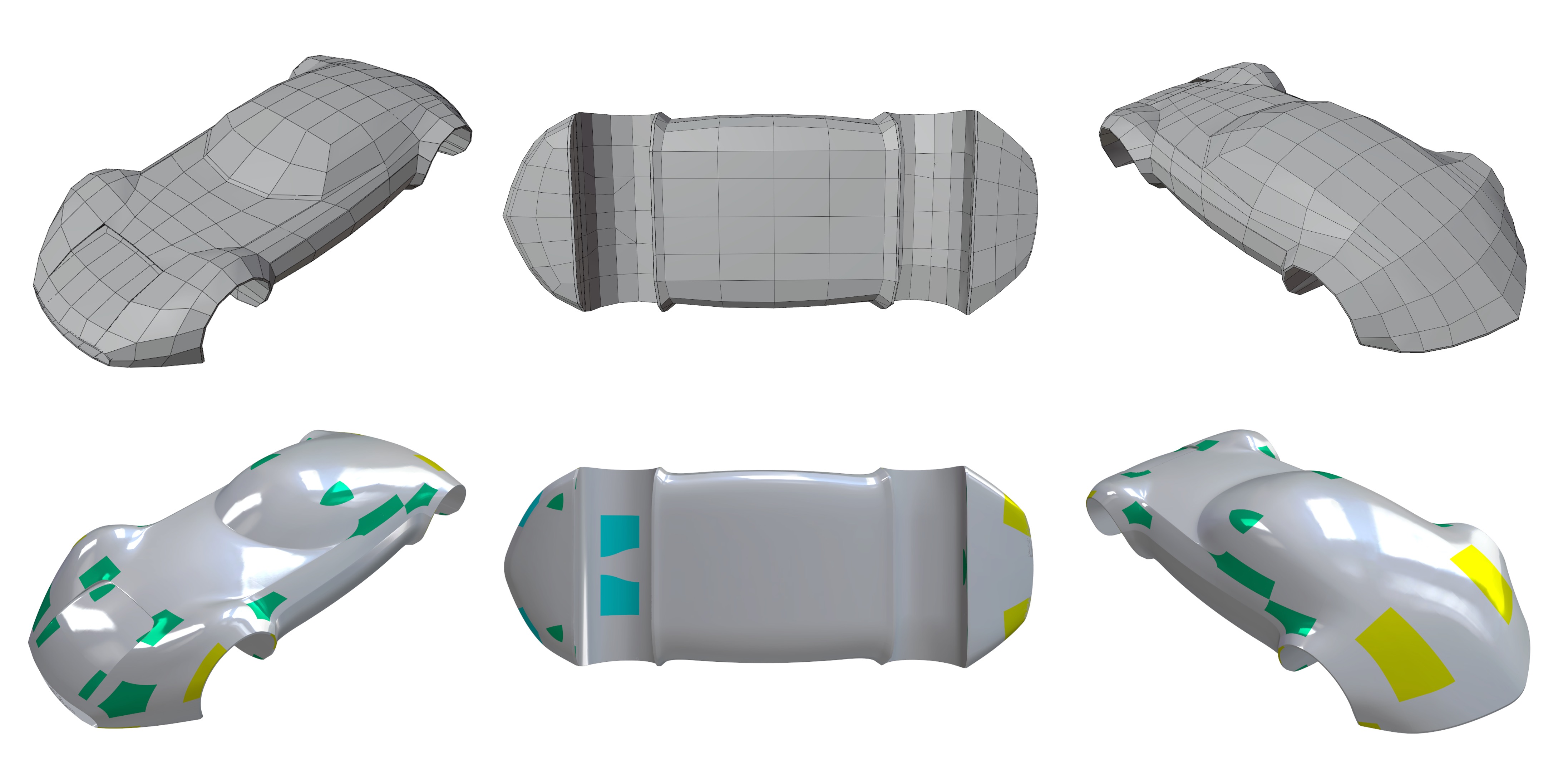
Top: input mesh, Bottom: B-spline patches generated by Polyhedral-net splines (Gray: regular Bi-2, Green: extraordinary point, Cyan: T0, Yellow: T1)
Features
- Smooth surfaces without subdividing the mesh.
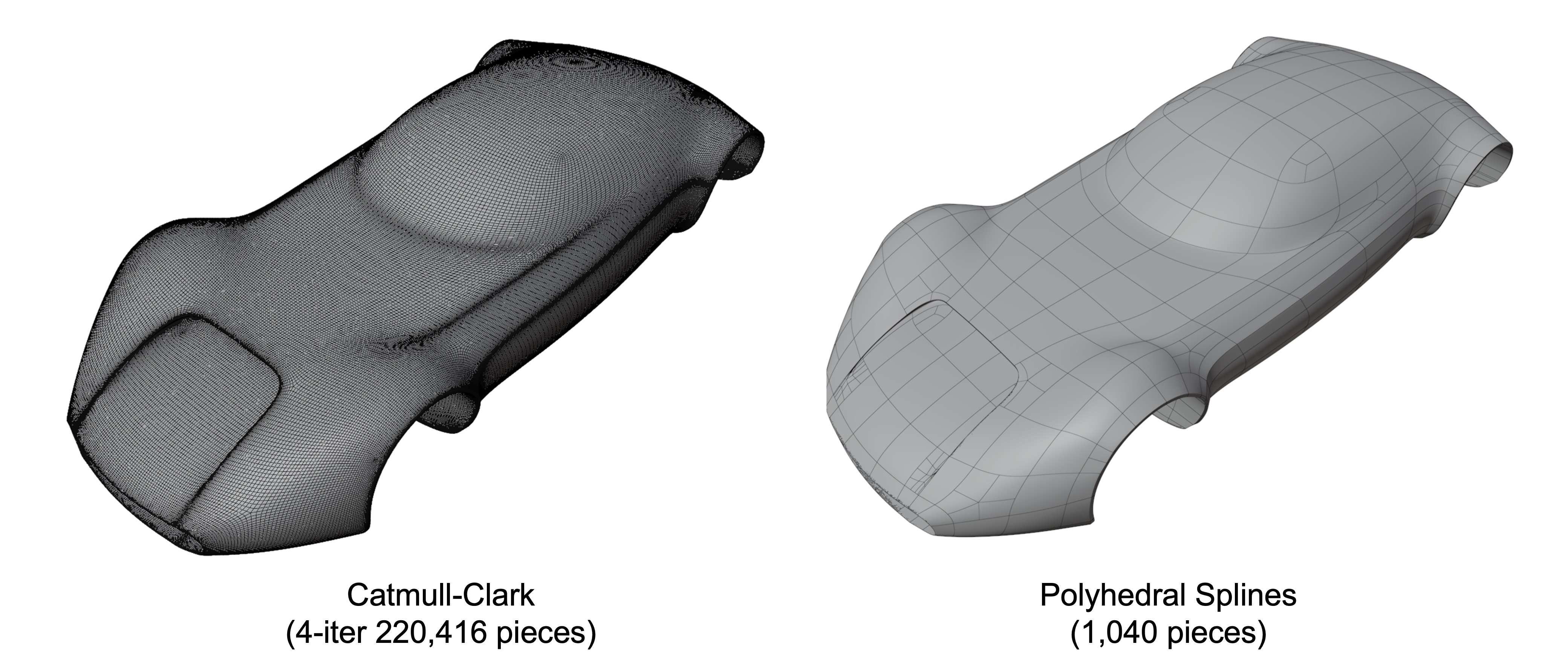
-
Easy, exact computation of moments, e.g. volume, center of mass, axes of inertia, …
- Preserves the polyhedral character of the input
(Polyhedral-net splines (PnS2) generalize bi-2, bi-quadratic, splines. Bi-2 splines are by default less smooth than bi-3 splines, and curvature changes more sharply.) - PnS3, a different package, generalizes bi-3 C2 splines
Installation
Usage
- Input: polyhedral-net in .obj file format
- Output: BB-patches of degree at most bi-3 in .bv, .igs, .step file format
For .bv output, see BView file introduction.
For .igs or .step output, see e.g. freeCAD
Execution
For UNIX-based systems
build/PolyhedralSplines [options] <input>
For Windows (PowerShell)
build\Debug\PolyhedralSplines.exe [options] <input>
Options
-h, --help: Show this help message and exit.-d, --DEGREE_RAISE: Raise degree-2 patches to degree 3.-f, --FORMAT <enum>: Output format: bv, igs, step (default: bv).
Positional arguments
input<string>: Input file (required). Example:mesh.obj
Usage Examples
build/PolyhedralSplines mesh.objbuild/PolyhedralSplines -d mesh.objbuild/PolyhedralSplines -f igs mesh.objbuild/PolyhedralSplines -d -f igs mesh.obj
Web Demo
Try out an interactive, in-browser visualization of polyhedral splines.
You can upload your own .obj files as control mesh and download .bv, .igs or .step.
Python Library
The Python library provide a programmatic interface to generate and export polyhedral spline surfaces.
- API Reference - full documentation of classes and functions.
- Sample Jupyter Notebook - step-by-step tutorial demonstrating common workflows on google colab.
C# Library
The C# library provide a programmatic interface to generate and export polyhedral spline surfaces.
- API Reference - full documentation of classes and functions.
Implemented algorithms
- Karčiauskas, K., & Peters, J. (2015). Smooth multi-sided blending of biquadratic splines. Computers & Graphics, 46, 172-185.
- Karčiauskas, K., & Peters, J. (2020). Smooth polar caps for locally quad-dominant meshes. Computer Aided Geometric Design, 81, 101908.
- Karčiauskas, K., & Peters, J. (2020). Low degree splines for locally quad-dominant meshes. Computer Aided Geometric Design, 83, 101934.
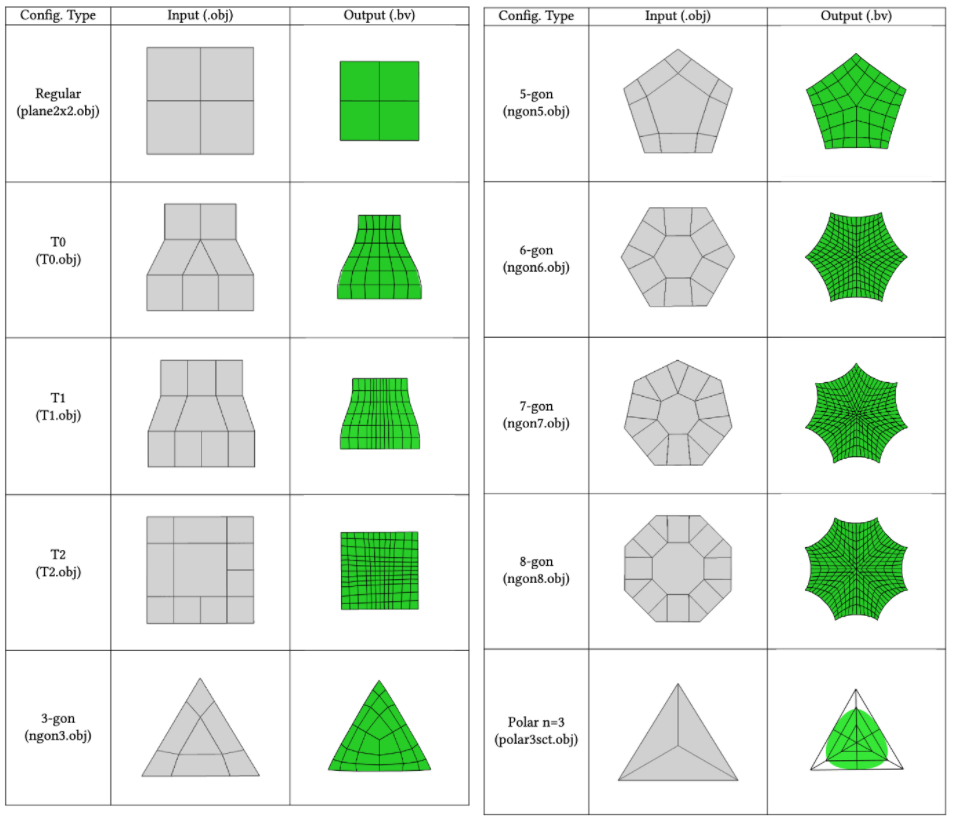
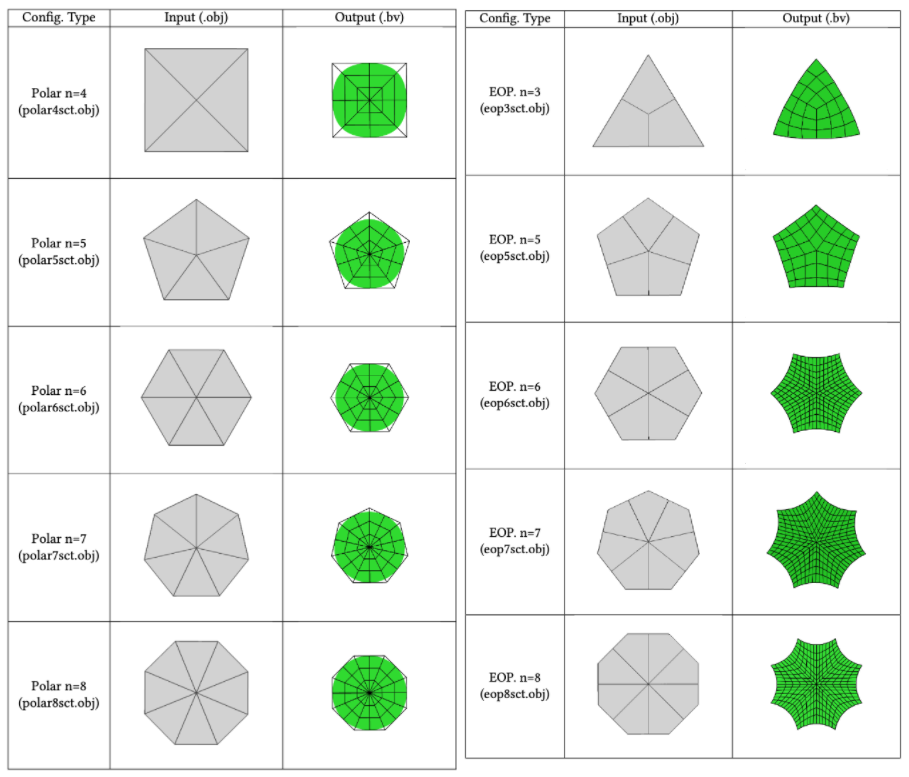
Allowable configurations
The single subdivision step will be applied automatically if any unsupported configuration is detected.
(gray: submesh / green: tensor-product splines)