Matrix: LPnetlib/lp_fit2p
Description: Netlib LP problem fit2p: minimize c'*x, where Ax=b, lo<=x<=hi
|
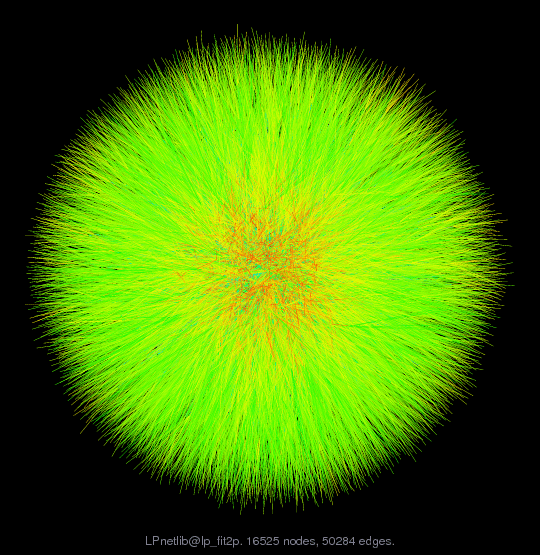
| (bipartite graph drawing) |
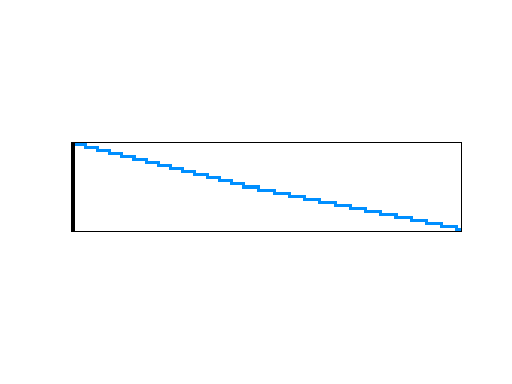 |
| Matrix properties | |
| number of rows | 3,000 |
| number of columns | 13,525 |
| nonzeros | 50,284 |
| structural full rank? | yes |
| structural rank | 3,000 |
| # of blocks from dmperm | 1 |
| # strongly connected comp. | 1 |
| explicit zero entries | 0 |
| nonzero pattern symmetry | 0% |
| numeric value symmetry | 0% |
| type | real |
| structure | rectangular |
| Cholesky candidate? | no |
| positive definite? | no |
| author | R. Fourer |
| editor | R. Fourer |
| date | 1990 |
| kind | linear programming problem |
| 2D/3D problem? | no |
| Additional fields | size and type |
| b | full 3000-by-1 |
| c | full 13525-by-1 |
| lo | full 13525-by-1 |
| hi | full 13525-by-1 |
| z0 | full 1-by-1 |
Notes:
A Netlib LP problem, in lp/data.  For more information
send email to netlib@ornl.gov with the message:

	 send index from lp
	 send readme from lp/data

The following are relevant excerpts from lp/data/readme (by David M. Gay):

The column and nonzero counts in the PROBLEM SUMMARY TABLE below exclude
slack and surplus columns and the right-hand side vector, but include
the cost row.  We have omitted other free rows and all but the first
right-hand side vector, as noted below.  The byte count is for the
MPS compressed file; it includes a newline character at the end of each
line.  These files start with a blank initial line intended to prevent
mail programs from discarding any of the data.  The BR column indicates
whether a problem has bounds or ranges:  B stands for "has bounds", R
for "has ranges".  The BOUND-TYPE TABLE below shows the bound types
present in those problems that have bounds.

The optimal value is from MINOS version 5.3 (of Sept. 1988)
running on a VAX with default options.

                       PROBLEM SUMMARY TABLE

Name       Rows   Cols   Nonzeros    Bytes  BR      Optimal Value
FIT2P      3001  13525    60784     439794  B     6.8464293232E+04

        BOUND-TYPE TABLE
FIT2P      UP

Supplied by Bob Fourer.

Concerning FIT1D, FIT1P, FIT2D, FIT2P, Bob Fourer says
    The pairs FIT1P/FIT1D and FIT2P/FIT2D are primal and
    dual versions of the same two problems [except that we
    have negated the cost coefficients of the dual problems
    so all are minimization problems].  They originate from
    a model for fitting linear inequalities to data, by
    minimization of a sum of piecewise-linear penalties.
    The FIT1 problems are based on 627 data points and 2-3
    pieces per primal pl penalty term.  The FIT2 problems
    are based on 3000 data points (from a different sample
    altogether) and 4-5 pieces per pl term.

Added to Netlib on  31 Jan. 1990
| Ordering statistics: | result |
| nnz(V) for QR, upper bound nnz(L) for LU, with COLAMD | 14,846,550 |
| nnz(R) for QR, upper bound nnz(U) for LU, with COLAMD | 4,501,500 |
| SVD-based statistics: | |
| norm(A) | 9377.31 |
| min(svd(A)) | 2 |
| cond(A) | 4688.65 |
| rank(A) | 3,000 |
| sprank(A)-rank(A) | 0 |
| null space dimension | 0 |
| full numerical rank? | yes |
| singular values (MAT file): | click here |
| SVD method used: | s = svd (full (A)) ; |
| status: | ok |
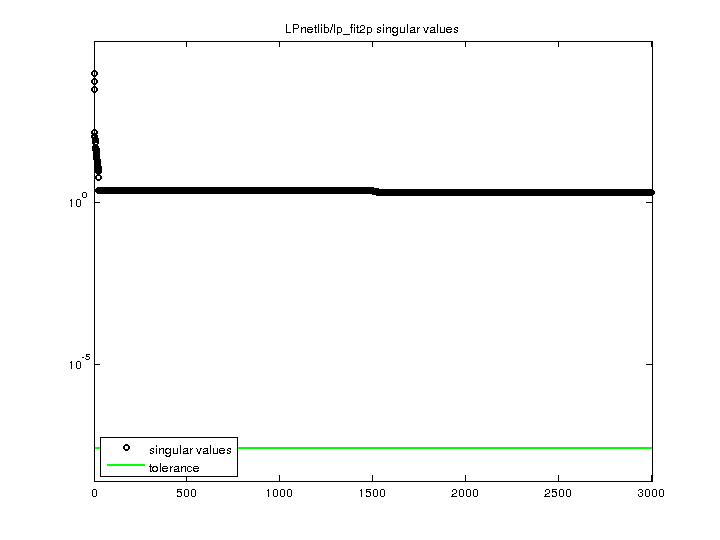
For a description of the statistics displayed above, click here.
Maintained by Tim Davis, last updated 12-Mar-2014.
Matrix pictures by cspy, a MATLAB function in the CSparse package.
Matrix graphs by Yifan Hu, AT&T Labs Visualization Group.